Professional services
Retrieval-augmented answers over private archives
On-premise RAG that answers from your documents with citations — built for firms whose archive cannot leave the building.
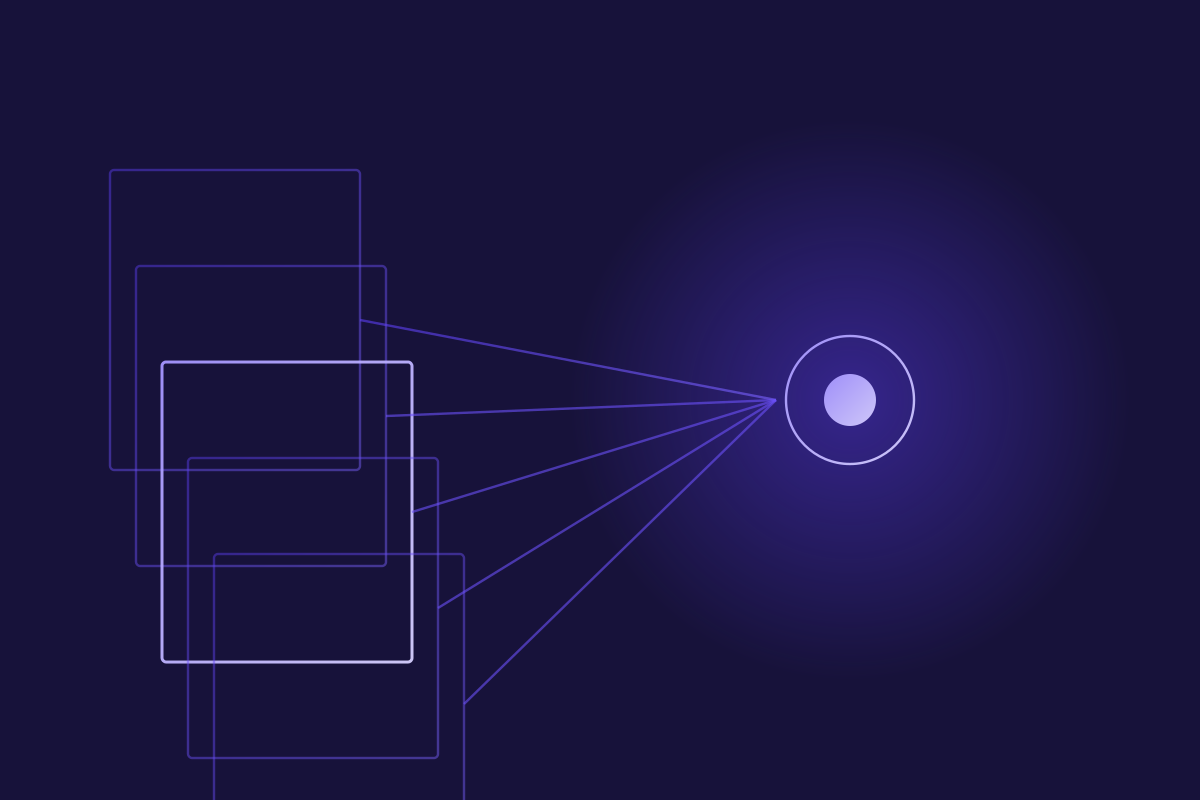
This page describes a problem class and the architecture we deploy for it, written against a named public benchmark — the open dataset or competition where the world's data scientists have tested approaches to this exact problem against a hard metric. It is not a client engagement, and the benchmark's results, prizes and rankings belong to its host and participants, not to us. Client work is confidential and is only ever published with written permission.
The problem
What it costs when this goes unsolved.
A professional firm's asset is its archive — matters, opinions, reports, precedents — and its constraint is that the archive is confidential. The useful system answers a professional's question from that archive with citations they can check, without a single document leaving infrastructure the firm controls. An answer without a citation is a liability in this setting, not a convenience.
Real archives are messy: scanned PDFs beside born-digital files, versions of the same document, privilege and access boundaries that retrieval must respect. The benchmark constraint set — no internet access, fixed compute, answers scored hard — mirrors the on-premise deployment exactly: retrieval quality, not model size, is what decides whether the system is trusted after week one.
How we build it
The architecture, stage by stage.
01
Chunking that follows document structure
Clauses, sections and headings drive the chunk boundaries, because retrieval quality is set at ingestion — a bad chunk cannot be rescued by a good model.
02
Hybrid retrieval with re-ranking
Dense embeddings and lexical search in tandem, then a cross-encoder re-ranker orders what the generator sees — the published recipe from the strongest offline-RAG work.
03
Grounded generation with citation discipline
Every answer carries its source passages; an answer the system cannot ground is declined, not improvised. Access boundaries are enforced at retrieval time per user.
04
Quantised open models on your hardware
Open-weight models served quantised on infrastructure you control — data sovereignty by architecture, not by contract clause.
Model families on this problem class: Hybrid retrieval + re-ranking · Open-weight LLMs, quantised · Structure-aware chunking · Access-controlled serving.
What you get
What an engagement hands over.
Everything below goes in the scope document before you sign it, with a fixed price or a rate with a ceiling — the same terms as every other engagement in the catalogue.
- A private RAG assistant over your archive, on your infrastructure
- Citation-first answering with per-user access enforcement
- A retrieval evaluation harness with your own domain questions
- A governance memo your clients and your insurers will accept
Provenance
The benchmark behind this page.
Kaggle LLM Science Exam, run by Kaggle, is the public proving ground for this problem class. The figures below are the host's, cited as context for how seriously this problem is tested in the open — they are not our results and we do not claim them.
How to buy this
The services this build draws on.
More proof

Next step
Thirty minutes on whether this fits your problem.
Bring the constraint — the regulator, the data boundary, the latency budget. If your data cannot support this build yet, the call will conclude with what to fix first, not with a proposal.